Hugging Face 公開ページを Markdown 化

モデルカード向け Hugging Face スクレイパー API

Hugging Face の URL を Crawl エンドポイントに送るだけ。モデル・データセットカード全文、Space のメタデータ、gated リポの正直な部分結果が返ります。アカウントは不要です。

エンドポイントbash
POST https://api.search1api.com/crawl
{ "url": "https://huggingface.co/google-bert/bert-base-uncased" }
対応しているページ

公開 Hub API とリポジトリの raw README を読む専用アダプター — SPA シェルではなくカード本体。

1
モデルカード

カード全文を Markdown で — downloads、likes、pipeline タグ、ライブラリはメタデータに。

2
データセットカード

同じメタデータ形状のデータセットカード — repoType でモデル・データセット・Space を区別。

3
gated リポも正直に

gated モデルは gated: true と明示メモ付きのメタデータを返却 — カード本文の捏造はしません。

用途

モデル調査 / データセット発掘 / 評価パイプライン

入力と出力

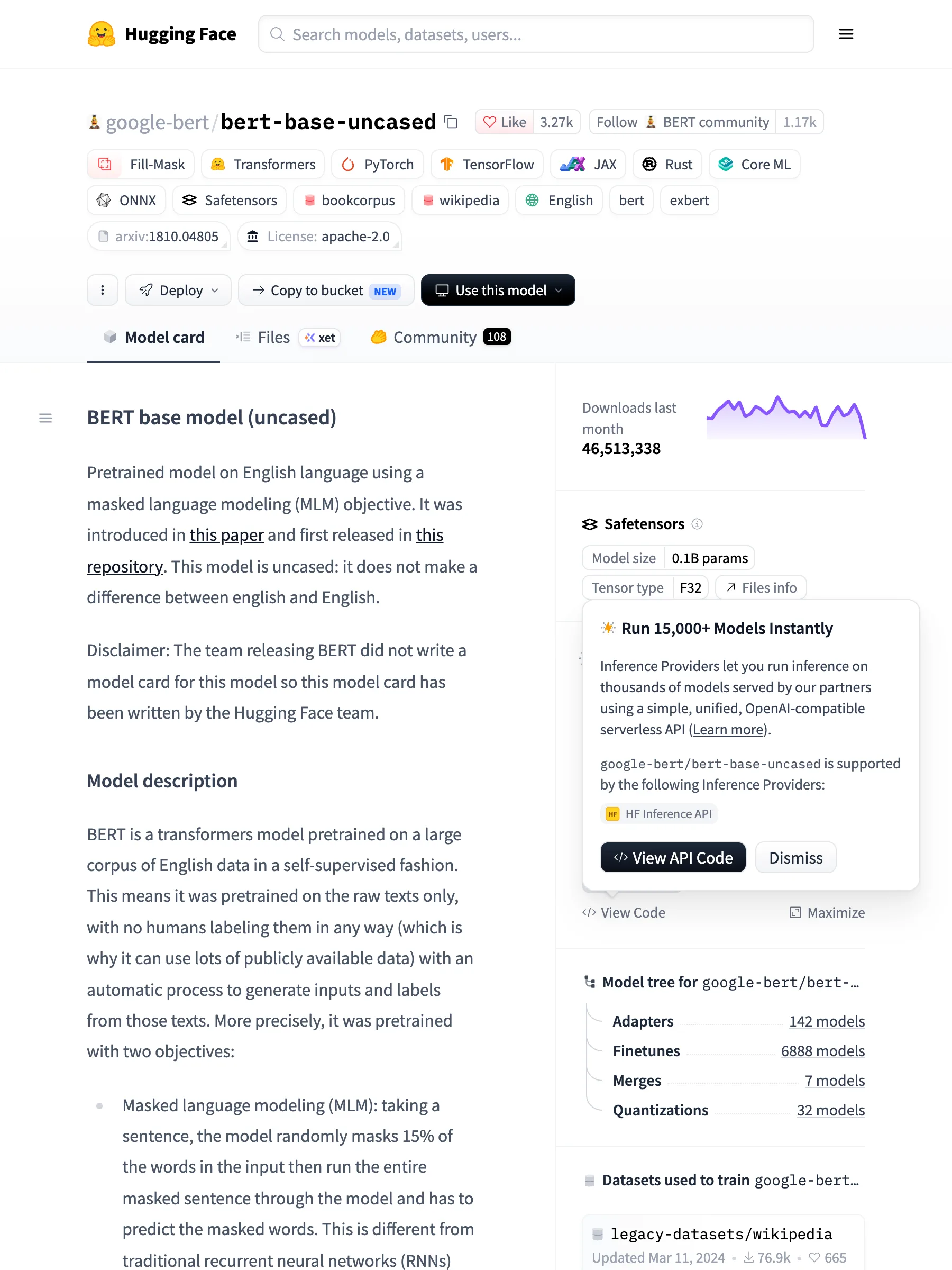
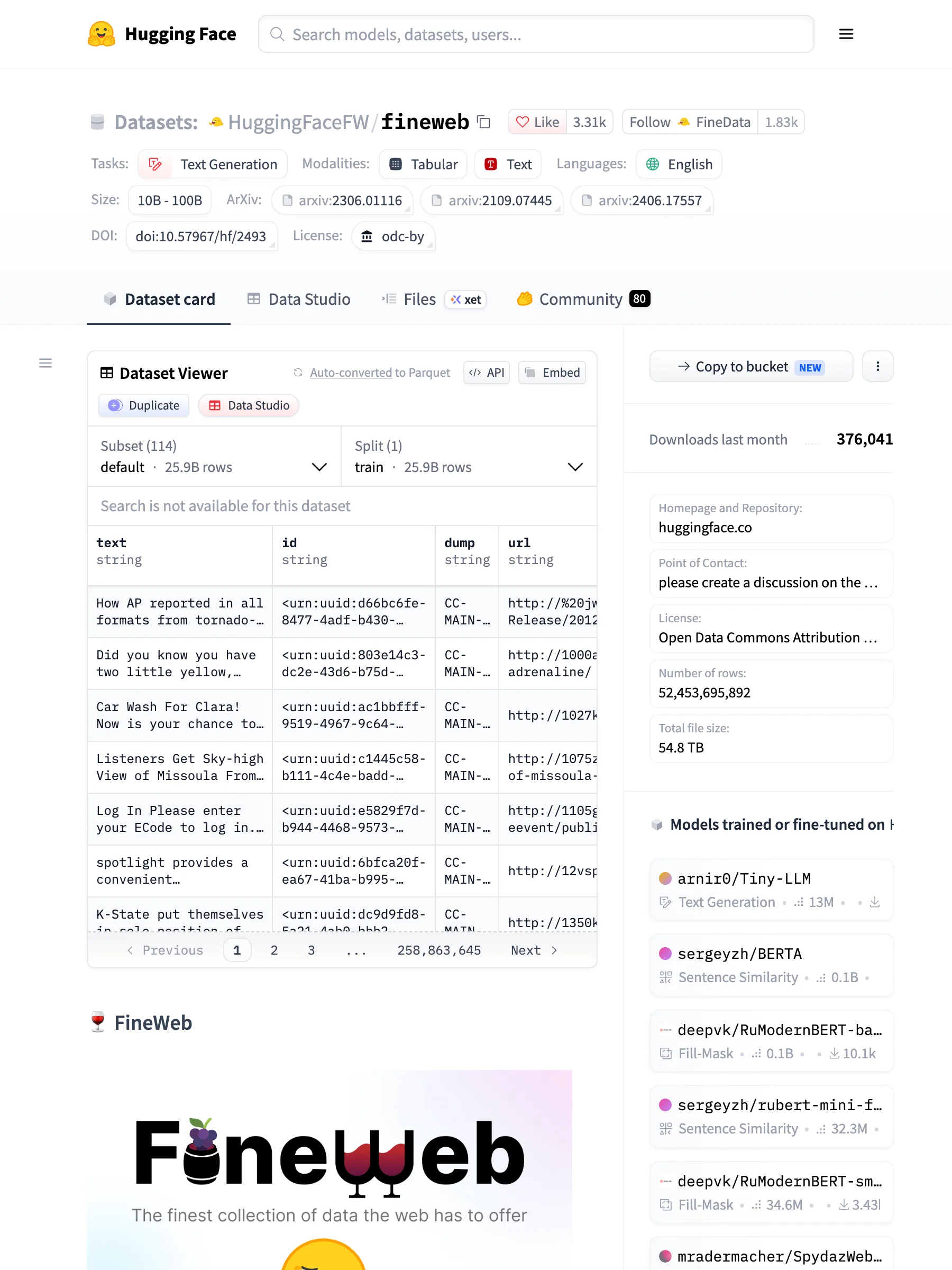
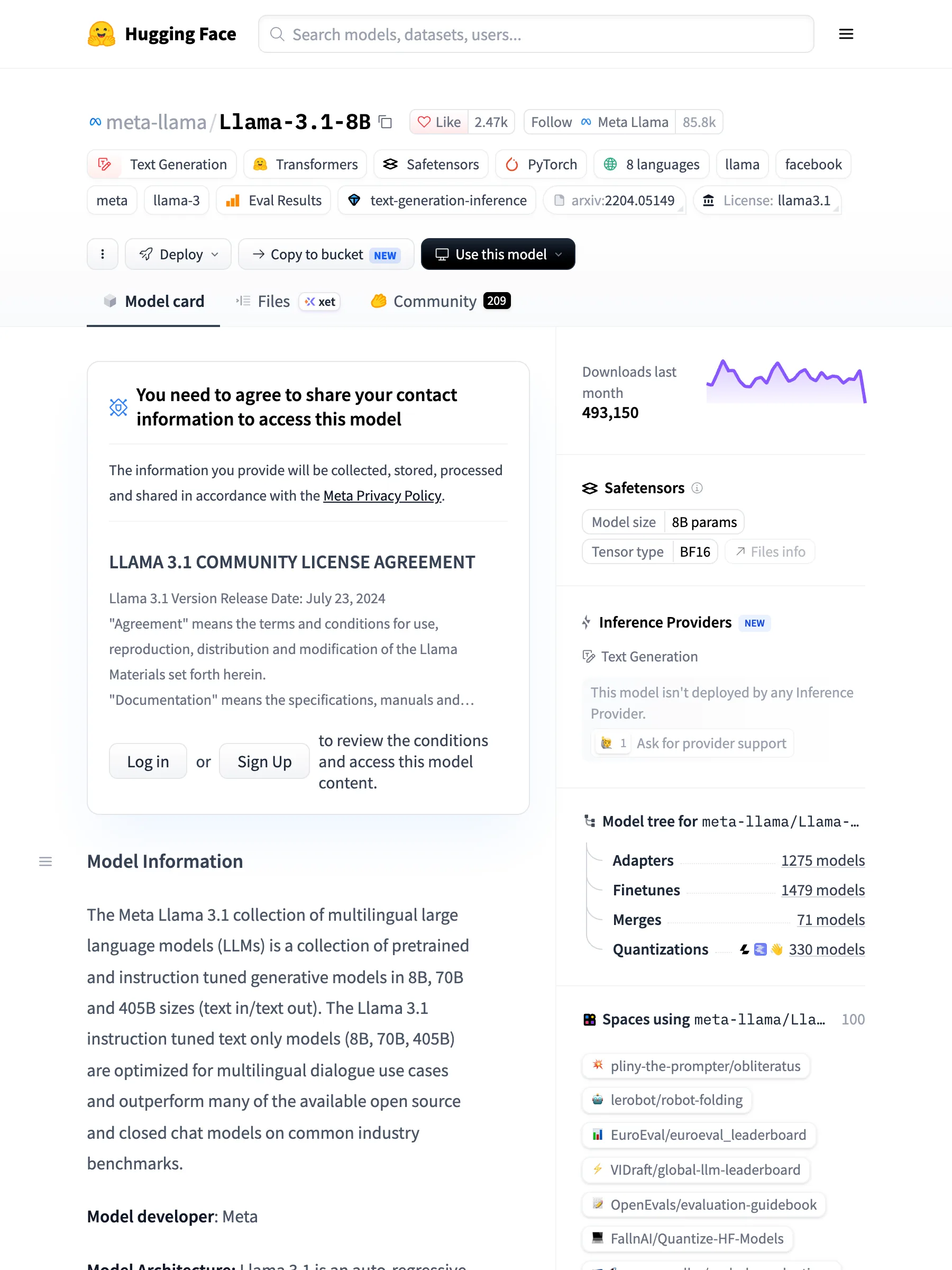
3 つの URL タイプ。左は Hugging Face が匿名訪問者に実際に配信する公開ページのスクリーンショット(クローラーと同じ経路で撮影)、右は API が返す results.content の全文です。

モデルカードhuggingface.co/google-bert/bert-base-uncased

Hugging Face が返すもの

匿名訪問者に配信される bert-base-uncased モデルページ

284 KB の描画 HTML — タグチップ、デプロイ widget、推論パネル込み

API が返すもの

markdown
# google-bert/bert-base-uncased
Type: Model · Task: fill-mask · Library: transformers · License: apache-2.0 · Downloads: 46,513,338 · Likes: 3,266 · Updated: 2024-02-19
Tags: transformers, pytorch, tf, jax, rust, coreml, onnx, safetensors, bert, fill-mask, exbert, en, endpoints_compatible
# BERT base model (uncased)
Pretrained model on English language using a masked language modeling (MLM) objective. It was introduced in
[this paper](https://arxiv.org/abs/1810.04805) and first released in
[this repository](https://github.com/google-research/bert). This model is uncased: it does not make a difference
between english and English.
Disclaimer: The team releasing BERT did not write a model card for this model so this model card has been written by
the Hugging Face team.
## Model description
BERT is a transformers model pretrained on a large corpus of English data in a self-supervised fashion. This means it
was pretrained on the raw texts only, with no humans labeling them in any way (which is why it can use lots of
publicly available data) with an automatic process to generate inputs and labels from those texts. More precisely, it
was pretrained with two objectives:
- Masked language modeling (MLM): taking a sentence, the model randomly masks 15% of the words in the input then run
the entire masked sentence through the model and has to predict the masked words. This is different from traditional
recurrent neural networks (RNNs) that usually see the words one after the other, or from autoregressive models like
GPT which internally masks the future tokens. It allows the model to learn a bidirectional representation of the
sentence.
- Next sentence prediction (NSP): the models concatenates two masked sentences as inputs during pretraining. Sometimes
they correspond to sentences that were next to each other in the original text, sometimes not. The model then has to
predict if the two sentences were following each other or not.
This way, the model learns an inner representation of the English language that can then be used to extract features
useful for downstream tasks: if you have a dataset of labeled sentences, for instance, you can train a standard
classifier using the features produced by the BERT model as inputs.
## Model variations
BERT has originally been released in base and large variations, for cased and uncased input text. The uncased models also strips out an accent markers.
Chinese and multilingual uncased and cased versions followed shortly after.
Modified preprocessing with whole word masking has replaced subpiece masking in a following work, with the release of two models.
Other 24 smaller models are released afterward.
The detailed release history can be found on the [google-research/bert readme](https://github.com/google-research/bert/blob/master/README.md) on github.
| Model | #params | Language |
|------------------------|--------------------------------|-------|
| [`bert-base-uncased`](https://huggingface.co/bert-base-uncased) | 110M | English |
| [`bert-large-uncased`](https://huggingface.co/bert-large-uncased) | 340M | English | sub
| [`bert-base-cased`](https://huggingface.co/bert-base-cased) | 110M | English |
| [`bert-large-cased`](https://huggingface.co/bert-large-cased) | 340M | English |
| [`bert-base-chinese`](https://huggingface.co/bert-base-chinese) | 110M | Chinese |
| [`bert-base-multilingual-cased`](https://huggingface.co/bert-base-multilingual-cased) | 110M | Multiple |
| [`bert-large-uncased-whole-word-masking`](https://huggingface.co/bert-large-uncased-whole-word-masking) | 340M | English |
| [`bert-large-cased-whole-word-masking`](https://huggingface.co/bert-large-cased-whole-word-masking) | 340M | English |
## Intended uses & limitations
You can use the raw model for either masked language modeling or next sentence prediction, but it's mostly intended to
be fine-tuned on a downstream task. See the [model hub](https://huggingface.co/models?filter=bert) to look for
fine-tuned versions of a task that interests you.
Note that this model is primarily aimed at being fine-tuned on tasks that use the whole sentence (potentially masked)
to make decisions, such as sequence classification, token classification or question answering. For tasks such as text
generation you should look at model like GPT2.
### How to use
You can use this model directly with a pipeline for masked language modeling:
```python
>>> from transformers import pipeline
>>> unmasker = pipeline('fill-mask', model='bert-base-uncased')
>>> unmasker("Hello I'm a [MASK] model.")
[{'sequence': "[CLS] hello i'm a fashion model. [SEP]",
'score': 0.1073106899857521,
'token': 4827,
'token_str': 'fashion'},
{'sequence': "[CLS] hello i'm a role model. [SEP]",
'score': 0.08774490654468536,
'token': 2535,
'token_str': 'role'},
{'sequence': "[CLS] hello i'm a new model. [SEP]",
'score': 0.05338378623127937,
'token': 2047,
'token_str': 'new'},
{'sequence': "[CLS] hello i'm a super model. [SEP]",
'score': 0.04667217284440994,
'token': 3565,
'token_str': 'super'},
{'sequence': "[CLS] hello i'm a fine model. [SEP]",
'score': 0.027095865458250046,
'token': 2986,
'token_str': 'fine'}]
```
Here is how to use this model to get the features of a given text in PyTorch:
```python
from transformers import BertTokenizer, BertModel
tokenizer = BertTokenizer.from_pretrained('bert-base-uncased')
model = BertModel.from_pretrained("bert-base-uncased")
text = "Replace me by any text you'd like."
encoded_input = tokenizer(text, return_tensors='pt')
output = model(**encoded_input)
```
and in TensorFlow:
```python
from transformers import BertTokenizer, TFBertModel
tokenizer = BertTokenizer.from_pretrained('bert-base-uncased')
model = TFBertModel.from_pretrained("bert-base-uncased")
text = "Replace me by any text you'd like."
encoded_input = tokenizer(text, return_tensors='tf')
output = model(encoded_input)
```
### Limitations and bias
Even if the training data used for this model could be characterized as fairly neutral, this model can have biased
predictions:
```python
>>> from transformers import pipeline
>>> unmasker = pipeline('fill-mask', model='bert-base-uncased')
>>> unmasker("The man worked as a [MASK].")
[{'sequence': '[CLS] the man worked as a carpenter. [SEP]',
'score': 0.09747550636529922,
'token': 10533,
'token_str': 'carpenter'},
{'sequence': '[CLS] the man worked as a waiter. [SEP]',
'score': 0.0523831807076931,
'token': 15610,
'token_str': 'waiter'},
{'sequence': '[CLS] the man worked as a barber. [SEP]',
'score': 0.04962705448269844,
'token': 13362,
'token_str': 'barber'},
{'sequence': '[CLS] the man worked as a mechanic. [SEP]',
'score': 0.03788609802722931,
'token': 15893,
'token_str': 'mechanic'},
{'sequence': '[CLS] the man worked as a salesman. [SEP]',
'score': 0.037680890411138535,
'token': 18968,
'token_str': 'salesman'}]
>>> unmasker("The woman worked as a [MASK].")
[{'sequence': '[CLS] the woman worked as a nurse. [SEP]',
'score': 0.21981462836265564,
'token': 6821,
'token_str': 'nurse'},
{'sequence': '[CLS] the woman worked as a waitress. [SEP]',
'score': 0.1597415804862976,
'token': 13877,
'token_str': 'waitress'},
{'sequence': '[CLS] the woman worked as a maid. [SEP]',
'score': 0.1154729500412941,
'token': 10850,
'token_str': 'maid'},
{'sequence': '[CLS] the woman worked as a prostitute. [SEP]',
'score': 0.037968918681144714,
'token': 19215,
'token_str': 'prostitute'},
{'sequence': '[CLS] the woman worked as a cook. [SEP]',
'score': 0.03042375110089779,
'token': 5660,
'token_str': 'cook'}]
```
This bias will also affect all fine-tuned versions of this model.
## Training data
The BERT model was pretrained on [BookCorpus](https://yknzhu.wixsite.com/mbweb), a dataset consisting of 11,038
unpublished books and [English Wikipedia](https://en.wikipedia.org/wiki/English_Wikipedia) (excluding lists, tables and
headers).
## Training procedure
### Preprocessing
The texts are lowercased and tokenized using WordPiece and a vocabulary size of 30,000. The inputs of the model are
then of the form:
```
[CLS] Sentence A [SEP] Sentence B [SEP]
```
With probability 0.5, sentence A and sentence B correspond to two consecutive sentences in the original corpus, and in
the other cases, it's another random sentence in the corpus. Note that what is considered a sentence here is a
consecutive span of text usually longer than a single sentence. The only constrain is that the result with the two
"sentences" has a combined length of less than 512 tokens.
The details of the masking procedure for each sentence are the following:
- 15% of the tokens are masked.
- In 80% of the cases, the masked tokens are replaced by `[MASK]`.
- In 10% of the cases, the masked tokens are replaced by a random token (different) from the one they replace.
- In the 10% remaining cases, the masked tokens are left as is.
### Pretraining
The model was trained on 4 cloud TPUs in Pod configuration (16 TPU chips total) for one million steps with a batch size
of 256. The sequence length was limited to 128 tokens for 90% of the steps and 512 for the remaining 10%. The optimizer
used is Adam with a learning rate of 1e-4, \\(\beta_{1} = 0.9\\) and \\(\beta_{2} = 0.999\\), a weight decay of 0.01,
learning rate warmup for 10,000 steps and linear decay of the learning rate after.
## Evaluation results
When fine-tuned on downstream tasks, this model achieves the following results:
Glue test results:
| Task | MNLI-(m/mm) | QQP | QNLI | SST-2 | CoLA | STS-B | MRPC | RTE | Average |
|:----:|:-----------:|:----:|:----:|:-----:|:----:|:-----:|:----:|:----:|:-------:|
| | 84.6/83.4 | 71.2 | 90.5 | 93.5 | 52.1 | 85.8 | 88.9 | 66.4 | 79.6 |
### BibTeX entry and citation info
```bibtex
@article{DBLP:journals/corr/abs-1810-04805,
author = {Jacob Devlin and
Ming{-}Wei Chang and
Kenton Lee and
Kristina Toutanova},
title = {{BERT:} Pre-training of Deep Bidirectional Transformers for Language
Understanding},
journal = {CoRR},
volume = {abs/1810.04805},
year = {2018},
url = {http://arxiv.org/abs/1810.04805},
archivePrefix = {arXiv},
eprint = {1810.04805},
timestamp = {Tue, 30 Oct 2018 20:39:56 +0100},
biburl = {https://dblp.org/rec/journals/corr/abs-1810-04805.bib},
bibsource = {dblp computer science bibliography, https://dblp.org}
}
```
<a href="https://huggingface.co/exbert/?model=bert-base-uncased">
<img width="300px" src="https://cdn-media.huggingface.co/exbert/button.png">
</a>

モデルカード全文 — 11 KB · downloads: 46.5M · pipelineTag: "fill-mask"

データセットカードhuggingface.co/datasets/HuggingFaceFW/fineweb

Hugging Face が返すもの

匿名訪問者に配信される FineWeb データセットページ

1.3 MB の描画 HTML — データセットビューア、ファイルブラウザ、設定パネル込み

API が返すもの

markdown
# HuggingFaceFW/fineweb
Type: Dataset · License: odc-by · Downloads: 376,041 · Likes: 3,311 · Updated: 2025-07-11
# 🍷 FineWeb
<center>
<img src="https://huggingface.co/datasets/HuggingFaceFW/admin/resolve/main/fineweb-logo.png" alt="FineWeb: The finest collection of data the web has to offer">
</center>
> 15 trillion tokens of the finest data the 🌐 web has to offer
# Table of Contents
- 🍷 FineWeb
* What is it?
* What is being released?
* Changelog
* How to download and use 🍷 FineWeb
+ Using 🏭 `datatrove`
+ Using `huggingface_hub`
+ Using `datasets`
* Breakdown by dump/crawl
* Dataset performance evaluation and ablations
+ Hyper-parameters for ablation models
+ Ablation evaluation benchmarks
+ Comparison with other datasets
- Dataset card for 🍷 FineWeb
* Dataset Summary
* Dataset Structure
+ Data Instances
+ Data Fields
+ Data Splits
* Dataset Creation
+ Curation Rationale
+ Source Data
+ Data processing steps
+ Annotations
+ Personal and Sensitive Information
* Considerations for Using the Data
+ Social Impact of Dataset
+ Discussion of Biases
+ Other Known Limitations
* Additional Information
+ Licensing Information
+ Future work
+ Citation Information
## What is it?
The 🍷 FineWeb dataset consists of more than **18.5T tokens** (originally 15T tokens) of cleaned and deduplicated english web data from CommonCrawl. The data processing pipeline is optimized for LLM performance and ran on the 🏭 [`datatrove`](https://github.com/huggingface/datatrove/) library, our large scale data processing library.
🍷 FineWeb was originally meant to be a fully open replication of 🦅 [RefinedWeb](https://huggingface.co/papers/2306.01116), with a release of the **full dataset** under the **ODC-By 1.0 license**. However, by carefully adding additional filtering steps, we managed to push the performance of 🍷 FineWeb well above that of the original 🦅 RefinedWeb, and models trained on our dataset also outperform models trained on other commonly used high quality web datasets (like C4, Dolma-v1.6, The Pile, SlimPajama, RedPajam2) on our aggregate group of [benchmark tasks](https://huggingface.co/datasets/HuggingFaceFW/fineweb/blob/main/lighteval_tasks.py).
That said, we think there is still room for additional filtering and improvement and intend to continue exploring how to improve the dataset quality in coming versions of 🍷 FineWeb.
## What is being released?
Along with the dataset, which includes all CommonCrawl dumps since 2013, we also share all the code needed to fully reproduce our processing setup using the 🏭 [`datatrove`](https://github.com/huggingface/datatrove/) library [here](https://github.com/huggingface/datatrove/blob/main/examples/fineweb.py). To enable full replication of our results, we have also published the small ablation models we have trained using [`nanotron`](https://github.com/huggingface/nanotron/) to validate the dataset and compare it with other reference datasets. You will find them [here](https://huggingface.co/collections/HuggingFaceFW/ablation-models-662457b0d213e8c14fe47f32), with checkpoints every 1000 steps. We have also published our evaluation results [here](https://huggingface.co/datasets/HuggingFaceFW/fineweb/blob/main/eval_results.csv). Our evaluation setup is available [here](https://huggingface.co/datasets/HuggingFaceFW/fineweb/blob/main/lighteval_tasks.py).
You will find details on the different processing decisions we took and some interesting explorations of deduplication methods on our [blogpost](https://huggingface.co/spaces/HuggingFaceFW/blogpost-fineweb-v1).
## Changelog
_Previous versions remain available in the branch `version name`._
- **v1.4.0 (11-07-2025):** Added 6 new snapshots: `CC-MAIN-2025-05`, `CC-MAIN-2025-08`, `CC-MAIN-2025-13`, `CC-MAIN-2025-18`, `CC-MAIN-2025-21`, and `CC-MAIN-2025-26` (January to June 2025)
- **v1.3.0 (31-01-2025):** Fixed an issue with some dumps where some documents hadn't been processed: `CC-MAIN-2024-10`, `CC-MAIN-2024-18`, `CC-MAIN-2024-22`, `CC-MAIN-2024-26`, `CC-MAIN-2024-30`, `CC-MAIN-2024-33`, `CC-MAIN-2024-38`, `CC-MAIN-2024-42`, `CC-MAIN-2024-46` -- they now contain more data (~400B additional tokens). We also removed specific domains in response to a [C&D notice](https://huggingface.co/datasets/huggingface-legal/takedown-notices/blob/main/2025/2025-01-22-Torstar.md).
- **v1.2.0 (03-01-2025):** Added 8 new snapshots: `CC-MAIN-2024-22`, `CC-MAIN-2024-26`, `CC-MAIN-2024-30`, `CC-MAIN-2024-33`, `CC-MAIN-2024-38`, `CC-MAIN-2024-42`, `CC-MAIN-2024-46`, `CC-MAIN-2024-51`, covering May to December 2024.
- **v1.1.0 (31-05-2024):** We reprocessed and reuploaded 11 dumps, `CC-MAIN-2021-49` to `CC-MAIN-2023-40`, as we found a bug on their deduplication. We also added the most recent dump: `CC-MAIN-2024-18`, crawled over April 2024. Expect a small perf improvement
- **v1.0.0 (21-04-2024):** Initial version
## How to download and use 🍷 FineWeb
You can load the full dataset or a specific crawl/dump (see table below). Dumps have the format `CC-MAIN-(year)-(week number)`.
### (Smaller) sample versions
Along with config `default` (all the data), and the configs for each individual dump, you can also download the following configs:
- `sample-350BT`: a subset randomly sampled from the whole dataset of around 350B gpt2 tokens (388GB)
- `sample-100BT`: a subset randomly sampled from the whole dataset of around 100B gpt2 tokens (277.4GB)
- `sample-10BT`: a subset randomly sampled from the whole dataset of around 10B gpt2 tokens (27.6GB)
`sample-10B` was sampled from `sample-100B` which in turn was sampled from `sample-350BT`.
### Using 🏭 [`datatrove`](https://github.com/huggingface/datatrove/)
```python
from datatrove.pipeline.readers import ParquetReader
# limit determines how many documents will be streamed (remove for all)
# to fetch a specific dump: hf://datasets/HuggingFaceFW/fineweb/data/CC-MAIN-2024-10
# replace "data" with "sample/100BT" to use the 100BT sample
data_reader = ParquetReader("hf://datasets/HuggingFaceFW/fineweb/data", limit=1000)
for document in data_reader():
# do something with document
print(document)
###############################
# OR for a processing pipeline:
###############################
from datatrove.executor import LocalPipelineExecutor
from datatrove.pipeline.readers import ParquetReader
from datatrove.pipeline.filters import LambdaFilter
from datatrove.pipeline.writers import JsonlWriter
pipeline_exec = LocalPipelineExecutor(
pipeline=[
# replace "data/CC-MAIN-2024-10" with "sample/100BT" to use the 100BT sample
ParquetReader("hf://datasets/HuggingFaceFW/fineweb/data/CC-MAIN-2024-10", limit=1000),
LambdaFilter(lambda doc: "hugging" in doc.text),
JsonlWriter("some-output-path")
],
tasks=10
)
pipeline_exec.run()
```
### Using `huggingface_hub`
```python
from huggingface_hub import snapshot_download
folder = snapshot_download(
"HuggingFaceFW/fineweb",
repo_type="dataset",
local_dir="./fineweb/",
# replace "data/CC-MAIN-2023-50/*" with "sample/100BT/*" to use the 100BT sample
allow_patterns="data/CC-MAIN-2023-50/*")
```
For faster downloads, make sure to install `pip install huggingface_hub[hf_transfer]` and set the environment variable `HF_HUB_ENABLE_HF_TRANSFER=1`.
### Using `datasets`
```python
from datasets import load_dataset
# use name="sample-10BT" to use the 10BT sample
fw = load_dataset("HuggingFaceFW/fineweb", name="CC-MAIN-2024-10", split="train", streaming=True)
```
## Breakdown by dump/crawl
| Dump | Time period | Disk size (GB) | gpt2 tokens (billions) |
| --- | --- |----------------|------------------------|
| CC-MAIN-2025-26 | June 2025 | 419.6 | 152.4 |
| CC-MAIN-2025-21 | May 2025 | 462.8 | 168.1 |
| CC-MAIN-2025-18 | April 2025 | 506.8 | 184.2 |
| CC-MAIN-2025-13 | March 2025 | 491.1 | 178.5 |
| CC-MAIN-2025-08 | February 2025 | 472.0 | 171.6 |
| CC-MAIN-2025-05 | January 2025 | 558.8 | 203.5 |
| CC-MAIN-2024-51 | December 2024 | 362.6 | 131.2 |
| CC-MAIN-2024-46 | November 2024 | 474.6 | 172.9 |
| CC-MAIN-2024-42 | October 2024 | 434.0 | 158.1 |
| CC-MAIN-2024-38 | September 2024 | 506.2 | 184.6 |
| CC-MAIN-2024-33 | August 2024 | 400.6 | 145.9 |
| CC-MAIN-2024-30 | July 2024 | 451.3 | 164.6 |
| CC-MAIN-2024-26 | June 2024 | 496.5 | 181.2 |
| CC-MAIN-2024-22 | May 2024 | 499.7 | 182.5 |
| CC-MAIN-2024-18 | April 2024 | 520.6 | 190.3 |
| CC-MAIN-2024-10 | February/March 2024 | 581.3 | 212.6 |
| CC-MAIN-2023-50 | November/December 2023 | 650.0 | 239.7 |
| CC-MAIN-2023-40 | September/October 2023 | 668.7 | 252.0 |
| CC-MAIN-2023-23 | May/June 2023 | 654.4 | 249.2 |
| CC-MAIN-2023-14 | March/April 2023 | 621.3 | 236.5 |
| CC-MAIN-2023-06 | January/February 2023 | 621.9 | 233.9 |
| CC-MAIN-2022-49 | November/December 2022 | 631.2 | 237.5 |
| CC-MAIN-2022-40 | September/October 2022 | 606.4 | 228.7 |
| CC-MAIN-2022-33 | August 2022 | 434.6 | 163.5 |
| CC-MAIN-2022-27 | June/July 2022 | 574.9 | 216.1 |
| CC-MAIN-2022-21 | May 2022 | 646.4 | 242.7 |
| CC-MAIN-2022-05 | January 2022 | 520.1 | 195.4 |
| CC-MAIN-2021-49 | November/December 2021 | 413.7 | 155.5 |
| CC-MAIN-2021-43 | October 2021 | 601.5 | 221.0 |
| CC-MAIN-2021-43 | October 2021 | 601.5 | 221.0 |
| CC-MAIN-2021-39 | September 2021 | 518.9 | 190.6 |
| CC-MAIN-2021-31 | July/August 2021 | 593.9 | 217.7 |
| CC-MAIN-2021-25 | June 2021 | 424.4 | 155.7 |
| CC-MAIN-2021-21 | May 2021 | 455.9 | 167.4 |
| CC-MAIN-2021-17 | April 2021 | 556.0 | 204.1 |
| CC-MAIN-2021-10 | February/March 2021 | 463.2 | 169.6 |
| CC-MAIN-2021-04 | January 2021 | 562.4 | 205.4 |
| CC-MAIN-2020-50 | November/December 2020 | 422.8 | 154.3 |
| CC-MAIN-2020-45 | October 2020 | 426.9 | 155.8 |
| CC-MAIN-2020-40 | September 2020 | 555.5 | 202.4 |
| CC-MAIN-2020-34 | August 2020 | 379.6 | 138.7 |
| CC-MAIN-2020-29 | July 2020 | 489.6 | 178.7 |
| CC-MAIN-2020-24 | May/June 2020 | 398.7 | 145.1 |
| CC-MAIN-2020-16 | March/April 2020 | 454.0 | 165.6 |
| CC-MAIN-2020-10 | February 2020 | 369.6 | 134.7 |
| CC-MAIN-2020-05 | January 2020 | 483.3 | 176.4 |
| CC-MAIN-2019-51 | December 2019 | 359.3 | 130.9 |
| CC-MAIN-2019-47 | November 2019 | 395.4 | 144.0 |
| CC-MAIN-2019-43 | October 2019 | 422.3 | 153.9 |
| CC-MAIN-2019-39 | September 2019 | 394.4 | 143.7 |
| CC-MAIN-2019-35 | August 2019 | 454.2 | 165.4 |
| CC-MAIN-2019-30 | July 2019 | 416.6 | 151.5 |
| CC-MAIN-2019-26 | June 2019 | 412.9 | 150.1 |
| CC-MAIN-2019-22 | May 2019 | 432.8 | 157.4 |
| CC-MAIN-2019-18 | April 2019 | 426.7 | 155.3 |
| CC-MAIN-2019-13 | March 2019 | 417.8 | 152.1 |
| CC-MAIN-2019-09 | February 2019 | 467.2 | 169.9 |
| CC-MAIN-2019-04 | January 2019 | 438.1 | 158.7 |
| CC-MAIN-2018-51 | December 2018 | 498.6 | 180.8 |
| CC-MAIN-2018-47 | November 2018 | 437.7 | 158.9 |
| CC-MAIN-2018-43 | October 2018 | 468.8 | 169.9 |
| CC-MAIN-2018-39 | September 2018 | 429.2 | 155.2 |
| CC-MAIN-2018-34 | August 2018 | 408.2 | 148.0 |
| CC-MAIN-2018-30 | July 2018 | 501.5 | 181.4 |
| CC-MAIN-2018-26 | June 2018 | 467.5 | 170.0 |
| CC-MAIN-2018-22 | May 2018 | 398.6 | 144.2 |
| CC-MAIN-2018-17 | April 2018 | 435.1 | 158.1 |
| CC-MAIN-2018-13 | March 2018 | 471.5 | 171.5 |
| CC-MAIN-2018-09 | February 2018 | 490.2 | 178.0 |
| CC-MAIN-2018-05 | January 2018 | 493.5 | 180.7 |
| CC-MAIN-2017-51 | December 2017 | 442.6 | 161.5 |
| CC-MAIN-2017-47 | November 2017 | 457.9 | 167.1 |
| CC-MAIN-2017-43 | October 2017 | 535.6 | 194.9 |
| CC-MAIN-2017-39 | September 2017 | 444.5 | 162.3 |
| CC-MAIN-2017-34 | August 2017 | 503.2 | 183.4 |
| CC-MAIN-2017-30 | July 2017 | 439.2 | 161.2 |
| CC-MAIN-2017-26 | June 2017 | 491.5 | 179.8 |
| CC-MAIN-2017-22 | May 2017 | 441.0 | 161.5 |
| CC-MAIN-2017-17 | April 2017 | 596.8 | 218.6 |
| CC-MAIN-2017-13 | March 2017 | 579.8 | 212.1 |
| CC-MAIN-2017-09 | February 2017 | 492.2 | 180.2 |
| CC-MAIN-2017-04 | January 2017 | 474.3 | 174.4 |
| CC-MAIN-2016-50 | December 2016 | 448.9 | 165.4 |
| CC-MAIN-2016-44 | October 2016 | 467.8 | 172.0 |
| CC-MAIN-2016-40 | September 2016 | 386.1 | 142.8 |
| CC-MAIN-2016-36 | August 2016 | 339.6 | 126.3 |
| CC-MAIN-2016-30 | July 2016 | 346.0 | 128.4 |
| CC-MAIN-2016-26 | June 2016 | 256.5 | 95.5 |
| CC-MAIN-2016-22 | May 2016 | 310.9 | 115.4 |
| CC-MAIN-2016-18 | April 2016 | 298.1 | 110.8 |
| CC-MAIN-2016-07 | February 2016 | 342.7 | 127.2 |
| CC-MAIN-2015-48 | November 2015 | 353.9 | 131.3 |
| CC-MAIN-2015-40 | September 2015 | 284.0 | 105.5 |
| CC-MAIN-2015-35 | August 2015 | 359.4 | 133.2 |
| CC-MAIN-2015-32 | July 2015 | 352.4 | 130.1 |
| CC-MAIN-2015-27 | June 2015 | 335.5 | 124.0 |
| CC-MAIN-2015-22 | May 2015 | 380.2 | 140.4 |
| CC-MAIN-2015-18 | April 2015 | 389.0 | 143.8 |
| CC-MAIN-2015-14 | March 2015 | 337.5 | 124.5 |
| CC-MAIN-2015-11 | February 2015 | 361.4 | 133.3 |
| CC-MAIN-2015-06 | January 2015 | 356.1 | 131.3 |
| CC-MAIN-2014-52 | December 2014 | 388.5 | 143.3 |
| CC-MAIN-2014-49 | November 2014 | 319.9 | 117.7 |
| CC-MAIN-2014-42 | October 2014 | 371.1 | 136.4 |
| CC-MAIN-2014-41 | September 2014 | 408.1 | 150.2 |
| CC-MAIN-2014-35 | August 2014 | 395.7 | 145.6 |
| CC-MAIN-2014-23 | July 2014 | 425.0 | 156.5 |
| CC-MAIN-2014-15 | April 2014 | 369.1 | 135.7 |
| CC-MAIN-2014-10 | March 2014 | 396.2 | 146.2 |
| CC-MAIN-2013-48 | Winter 2013 | 396.8 | 145.9 |
| CC-MAIN-2013-20 | Summer 2013 | 393.9 | 144.5 |
| Total | | 50,446.9 | 18,527.0 |
## Dataset performance evaluation and ablations
We conducted our dataset performance ablations and evaluations by training a series of 1.8B parameters models on 27 billion tokens. To compare 🍷 FineWeb with other datasets, we also trained one of these 1.8B models per target dataset, on 350 billion tokens sampled from it (or the entire dataset when its size was < 350 billion tokens).
### Hyper-parameters for ablation models
The detailed configurations for training the 1.8B parameters ablation model can be found here (link will be added soon).
### Ablation evaluation benchmarks
To conduct the ablations for each of our dataset filtering choices, we selected a set of benchmarks which we identified as “high-signal” benchmarks. These benchmarks were selected according to the following criteria:
- small variance between runs trained on different samplings of the same dataset
- performance increasing monotically during training (or close)
- separation between runs on datasets of known quality (C4, The Pile, RedPajama) higher than the variance between runs with various modeling/data seeds
We used the following list of benchmark for our ablation runs:
- commonsense_qa (acc/acc_norm)
- hellaswag (acc/acc_norm)
- openbookqa (acc/acc_norm)
- piqa (acc/acc_norm)
- siqa (acc/acc_norm)
- winogrande (acc/acc_norm)
- arc (acc/acc_norm)
- mmlu (acc/acc_norm)
To compare runs we consider an aggregate score, the average of the scores for these tasks.
The prompts for all these benchmarks are formatted in order to compute and compare the log-likelihood of the full answers for each multiple choice question. All the implementation details for the benchmarks are available in `lighteval` [here](https://huggingface.co/datasets/HuggingFaceFW/fineweb/blob/main/lighteval_tasks.py).
### Comparison with other datasets
We compared 🍷 FineWeb with the following datasets:
- [RefinedWeb](https://huggingface.co/datasets/tiiuae/falcon-refinedweb)
- [C4](https://huggingface.co/datasets/allenai/c4)
- [Dolma v1.6](https://huggingface.co/datasets/allenai/dolma) (the CommonCrawl part)
- [The Pile](https://huggingface.co/datasets/EleutherAI/pile)
- [SlimPajama](https://huggingface.co/datasets/cerebras/SlimPajama-627B)
- [RedPajama2](https://huggingface.co/datasets/togethercomputer/RedPajama-Data-V2) (deduplicated)
You will find these models on [this collection](https://huggingface.co/collections/HuggingFaceFW/ablation-models-662457b0d213e8c14fe47f32). We have uploaded checkpoints at every 1000 training steps. You will also find our full [evaluation results here](https://huggingface.co/datasets/HuggingFaceFW/fineweb/blob/main/eval_results.csv).
<center>
<img src="https://huggingface.co/datasets/HuggingFaceFW/admin/resolve/main/fineweb-ablations.png" alt="ablations">
</center>
_Note:_ The plot is smoothed by averaging 5k steps in a rolling window.
# Dataset card for 🍷 FineWeb
## Dataset Description
- **Homepage and Repository:** [https://huggingface.co/datasets/HuggingFaceFW/fineweb](https://huggingface.co/datasets/HuggingFaceFW/fineweb)
- **Point of Contact:** please create a discussion on the Community tab
- **License:** Open Data Commons Attribution License (ODC-By) v1.0
### Dataset Summary
This dataset was created by processing 96 [CommonCrawl](https://commoncrawl.org/) dumps comprising web data crawled from the summer of 2013 to April of 2024. 🍷 FineWeb includes a variety of domains and topics in English and is primarily intended to be used as a research artifact on public data in the context of pretraining dataset for large language models. The CommonCrawl data was carefully processed, filtered and deduplicated with the 🏭 [`datatrove`](https://github.com/huggingface/datatrove/) library, resulting in the largest publicly available clean LLM pretraining dataset, counting around 15 trillion tokens (gpt2 tokenizer).
## Dataset Structure
### Data Instances
The following is an example sample from the dataset. It is part of the `CC-MAIN-2021-43` and was crawled on `2021-10-15T21:20:12Z`.
```json
{
"text": "This is basically a peanut flavoured cream thickened with egg yolks and then set into a ramekin on top of some jam. Tony, one of the Wedgwood chefs, suggested sprinkling on some toasted crushed peanuts at the end to create extra crunch, which I thought was a great idea. The result is excellent.",
"id": "<urn:uuid:e5a3e79a-13d4-4147-a26e-167536fcac5d>",
"dump": "CC-MAIN-2021-43",
"url": "<http://allrecipes.co.uk/recipe/24758/peanut-butter-and-jam-creme-brulee.aspx?o_is=SimilarRecipes&o_ln=SimRecipes_Photo_7>",
"date": "2021-10-15T21:20:12Z",
"file_path": "s3://commoncrawl/crawl-data/CC-MAIN-2021-43/segments/1634323583083.92/warc/CC-MAIN-20211015192439-20211015222439-00600.warc.gz",
"language": "en",
"language_score": 0.948729,
"token_count": 69
}
```
### Data Fields
- `text` (string): the main text content
- `id` (string): original unique identifier for this sample from CommonCrawl
- `dump` (string): the CommonCrawl dump this sample was a part of
- `url` (string): url to the original page where `text` was present
- `date` (string): crawl date (from CommonCrawl)
- `file_path` (string): s3 path for the individual CommonCrawl warc file containing this sample
- `language` (string): `en` for all the samples in this dataset
- `language_score` (float): language prediction score (`0.01.0`) as reported by the [fastText language classifier](https://github.com/huggingface/datatrove/blob/main/src/datatrove/pipeline/filters/language_filter.py)
- `token_count` (int): number of tokens when applying the `gpt2` tokenizer to this sample
### Data Splits
The `default` subset includes the entire dataset. If you would like to only use the data from a particular [CommonCrawl dump](https://commoncrawl.org/overview), you can use the dump name as a subset. You will find the full list of available dumps on the table above.
From experiments we have run, not all dumps give the same performance. For relatively small trainings (<550 billion tokens) we recommend using the recent `CC-MAIN-2023-50`, `CC-MAIN-2024-10` and `CC-MAIN-2024-18`.
## Dataset Creation
### Curation Rationale
While multiple open-weights models have regularly been released in recent months, these releases often do not include the model's training data. With 🍷 FineWeb we aim to provide the open source community with a very large clean pretraining dataset that can be used to push the envelope on truly open source models (open source models where data is also released).
### Source Data
The source data consists of webpages crawled by the CommonCrawl foundation over the 2013-2024 time period.
We then extracted the main page text from the html of each webpage, carefully filtered each sample and deduplicated each individual CommonCrawl dump/crawl.
While we originally intended to deduplicate the dataset as a whole, our ablations showed that training on a sampling of individually deduplicated dumps/crawls outperformed training on a sampling of all the dumps/crawls deduplicated together. You will find more details on our [blogpost](https://huggingface.co/spaces/HuggingFaceFW/blogpost-fineweb-v1).
### Data processing steps
We used the 🏭 `datatrove` library to process the data.
You can find a **working script** that launches the [entire processing pipeline here](https://github.com/huggingface/datatrove/blob/main/examples/fineweb.py).
The data processing pipeline consists of:
1. [Url Filtering](https://github.com/huggingface/datatrove/blob/9a88bebc86a554f8521faa70b12ad4fa0c227537/src/datatrove/pipeline/filters/url_filter.py), removing documents originating from Malicious and NSFW websites, using both block-list as well as subwords detection
2. [Trafilatura](https://github.com/huggingface/datatrove/blob/9a88bebc86a554f8521faa70b12ad4fa0c227537/src/datatrove/pipeline/extractors/trafilatura.py) text extraction on the raw HTML from CommonCrawl’s warc files
3. [FastText LanguageFilter](https://github.com/huggingface/datatrove/blob/9a88bebc86a554f8521faa70b12ad4fa0c227537/src/datatrove/pipeline/filters/language_filter.py), removing any document with `en` language score lower than **0.65**
4. Quality filtering
1. [Gopher Repetition /](https://github.com/huggingface/datatrove/blob/9a88bebc86a554f8521faa70b12ad4fa0c227537/src/datatrove/pipeline/filters/gopher_repetition_filter.py) [Quality](https://github.com/huggingface/datatrove/blob/9a88bebc86a554f8521faa70b12ad4fa0c227537/src/datatrove/pipeline/filters/gopher_quality_filter.py)
2. [C4 Quality filters](https://github.com/huggingface/datatrove/blob/9a88bebc86a554f8521faa70b12ad4fa0c227537/src/datatrove/pipeline/filters/c4_quality_filter.py) except `terminal_punct` rule
3. [FineWeb custom filters](https://github.com/huggingface/datatrove/blob/05194d3960741e7d5c0bd0d6dd69d44514622549/src/datatrove/pipeline/filters/fineweb_quality_filter.py), consisting of heuristics for removing list-like documents, documents with repeated lines and documents with likely wrong line formatting.
5. [MinHash deduplication](https://github.com/huggingface/datatrove/blob/6daa5e879e06b21e6886b37e2b1be4ae58a658b6/src/datatrove/pipeline/dedup/minhash.py) with each crawl deduplicated individually (5-grams, 14x8 hash functions)
6. [PII Formatting](https://github.com/huggingface/datatrove/blob/main/src/datatrove/pipeline/formatters/pii.py) to anonymize email and public IP addresses
### Annotations
We augment the original samples with the `language`, `language_score` and `token_count` annotations. The language related annotations are automatically generated by our [language filter](https://github.com/huggingface/datatrove/blob/main/src/datatrove/pipeline/filters/language_filter.py). `token_count` is generated by [applying the gpt2 tokenizer](https://github.com/huggingface/datatrove/blob/main/src/datatrove/pipeline/tokens/counter.py) to the `text` column.
### Personal and Sensitive Information
We anonymize email addresses and public IP addresses.
For emails, we apply a regex pattern and replace any occurrence of an email address with either `email@example.com` or `firstname.lastname@example.org`. For IP addresses, we also employ a regex pattern and then further filter to only anonymize IP addresses [allocated for public networks](https://www.iana.org/assignments/iana-ipv4-special-registry/iana-ipv4-special-registry.xhtml). Matched IP addresses are then replaced with one of the following randomly generated IP addresses, which at the time of dataset creation were not responding to ping requests: `22.214.171.124`, `126.96.36.199`, `188.8.131.52`, `184.108.40.206`, `220.127.116.11`, and `18.104.22.168`. We decided against applying regex patterns for phone numbers due to the high false positive rate.
Despite our efforts, given that 🍷 FineWeb is sourced from the internet at large, it is very likely that some personable identifiable information (PII) will be present. If you find your own PII in 🍷 FineWeb and would like it removed, please fill out our [PII removal form](https://forms.gle/VyNT3ZAUPZjPuWp39).
## Considerations for Using the Data
### Social Impact of Dataset
With the release of this dataset we aim to make model training more accessible to the machine learning community at large.
While multiple open-weights models with strong performance have been publicly released in the past, more often than not these releases are not accompanied by the corresponding training dataset. This is unfortunate as the dataset specificities and characteristics have been demonstrated to have a very large impact and role in the performances of the models. As the creation of a high quality training dataset is a fundamental requirement to training an LLM capable of excelling at downstream tasks, with 🍷 FineWeb we (a) not only make the dataset creation process more transparent, by sharing our entire processing setup including the codebase used, we also (b) help alleviate the costs of dataset curation, both in time and in compute, for model creators by publicly releasing our dataset with the community.
### Discussion of Biases
Efforts were made to minimize the amount of NSFW and toxic content present in the dataset by employing filtering on the URL level. However, there are still a significant number of documents present in the final dataset that could be considered toxic or contain harmful content. As 🍷 FineWeb was sourced from the web as a whole, any harmful biases typically present in it may be reproduced on our dataset.
We deliberately avoided using machine learning filtering methods that define text quality based on the similarity to a “gold” source such as wikipedia or toxicity classifiers as these methods have been known to [disproportionately remove content in specific dialects](https://aclanthology.org/D16-1120/) and [overclassify as toxic text related to specific social identities](https://arxiv.org/pdf/2109.07445.pdf), respectively.
### Other Known Limitations
As a consequence of some of the filtering steps applied, it is likely that code content is not prevalent in our dataset. If you are training a model that should also perform code tasks, we recommend you use 🍷 FineWeb with a code dataset, such as [The Stack v2](https://huggingface.co/datasets/bigcode/the-stack-v2). You should also probably consider complementing 🍷 FineWeb with specialized curated sources (such as Wikipedia, for example) as they will likely have better formatting than the wikipedia content included in 🍷 FineWeb (we did not tailor the processing to individual websites).
## Additional Information
### Licensing Information
The dataset is released under the **Open Data Commons Attribution License (ODC-By) v1.0** [license](https://opendatacommons.org/licenses/by/1-0/). The use of this dataset is also subject to [CommonCrawl's Terms of Use](https://commoncrawl.org/terms-of-use).
### Future work
We plan to not only continue but also expand our efforts to create open-source high quality training datasets and to improve 🍷 FineWeb itself in future iterations.
## Citation Information
Paper on [arXiv](https://arxiv.org/abs/2406.17557)
```
@inproceedings{
penedo2024the,
title={The FineWeb Datasets: Decanting the Web for the Finest Text Data at Scale},
author={Guilherme Penedo and Hynek Kydl{\'\i}{\v{c}}ek and Loubna Ben allal and Anton Lozhkov and Margaret Mitchell and Colin Raffel and Leandro Von Werra and Thomas Wolf},
booktitle={The Thirty-eight Conference on Neural Information Processing Systems Datasets and Benchmarks Track},
year={2024},
url={https://openreview.net/forum?id=n6SCkn2QaG}
}
```

データセットカード全文 — 31 KB · downloads: 376K · repoType: "datasets"

gated モデルhuggingface.co/meta-llama/Llama-3.1-8B

Hugging Face が返すもの

ライセンス同意ウォールが表示された gated Llama-3.1-8B ページ

415 KB の描画 HTML — カードはライセンス同意の内側

API が返すもの

markdown
# meta-llama/Llama-3.1-8B
Type: Model · Task: text-generation · Library: transformers · License: llama3.1 · Downloads: 493,150 · Likes: 2,471 · Updated: 2024-10-16 · Gated: yes
Tags: transformers, safetensors, llama, text-generation, facebook, meta, pytorch, llama-3, en, de, fr, it, pt, hi, es
_Model card is gated; metadata only._

メタデータカード — 335 B · gated: true · 本文不在を正直に明示

URL パターン別の対応状況

Hugging Face 対応はドメイン単位ではなく URL パターン単位で計測しています。表の各行は本番クローラーで検証済みです。

URL パターンステータス取得できる内容
/<org>/<model>
対応
モデルカード全文を Markdown で — README 本文に加え Hub API のタグ・ライセンス・ライブラリ。
/datasets/<org>/<name>
対応
同じ形状のデータセットカード — 全文に加え downloads と likes がメタデータに。
/spaces/<org>/<name>
対応
メタデータカード — タイプ・ライセンス・likes・タグ。Space に長文カード本体はありません。
gated リポジトリ
メタデータのみ
gated モデル・データセットは gated: true と明示メモ付きのメタデータを返却 — カード本文は誰にも偽造できない同意が必要です。

SPA シェルなしでモデルカードを取得

Hugging Face のページはカード文書を包む JavaScript シェルです。Crawl エンドポイントにリポ URL を渡すと、公開 Hub API とリポジトリの raw README を呼ぶ専用アダプターにルーティングされます — カードは downloads、likes、pipeline タグ入りの構造化メタデータとともに Markdown で返ります。

API と raw カードの合成

アダプターは Hub API レコードとリポジトリの raw README を組み合わせ — 構造化フィールドと著者の書いたカード本文が 1 レスポンスに。

gated は gated のまま

gated リポは公開メタデータに gated: true と「カードは gated」の明示メモを返します — パイプラインは同意ウォールを削るのでなく事実を知れます。

構造化メタデータで振り分け

results.metadata に repoType、pipelineTag、library、downloads、likes が入ります — カード本文を解析せずに条件分岐できます。

URL パターンごとに実測

表の各行は実際の URL をライブでクロールして再現したもの — ドメイン単位の主張ではなく、パターン単位の実測です。

Hugging Face スクレイパー API とは?

Hugging Face スクレイパー API は、Hugging Face URL を受け取りリポジトリのカードを構造化されたモデル向け形式で返す HTTP インターフェースです。Web ページは SPA シェルで、中身は README カードと Hub メタデータレコードです。Search1API の Crawl エンドポイントは両方を直接読み取ります — downloads、likes、pipeline タグなどのフィールドは公開 Hub API から、著者の書いたカードはリポジトリの raw ファイルから — ページをレンダリングせずにモデル・データセット・Space のカードが Markdown で返ります。

実装の流れ

典型的なワークフロー

Hugging Face の URL を Crawl エンドポイントに送るだけ。モデル・データセットカード全文、Space のメタデータ、gated リポの正直な部分結果が返ります。アカウントは不要です。

1

Hugging Face URL を Crawl エンドポイントに POST — アカウントは不要。

2

URL がパターンルールに照合され、Hugging Face アダプターにルーティングされます。

3

カードが Markdown と results.metadata で返却 — repoType、pipelineTag、downloads、likes、gated。

4

gated リポは明示メモ付きのメタデータカードを返却 — 境界は隠さず命名します。

利用シーン

モデル・データセットカードを索引化して社内ディスカバリへ — downloads と likes はソート可能なフィールドで到着。

モデルファミリーの追跡 — カードとメタデータでタスク・ライブラリ・ライセンスが 1 コールで判明。

アクセス申請前の gated リポ選別 — メタデータカードが壁なしでライセンスと統計を返します。

pipelineTag と library で分岐する評価パイプラインへの投入 — 散文の解析は不要。

FAQ

Hugging Face アカウントやトークンは必要ですか?

不要です。アダプターは公開 Hub API エンドポイントと raw リポファイルを読み取ります — 読み取り経路にトークンはありません。gated リポは公開メタデータと明示的な gated フラグを返します。

どの Hugging Face URL に対応していますか?

モデルページ(/<org>/<model>)、データセットページ(/datasets/<org>/<name>)、Space ページ(/spaces/<org>/<name>)に対応。Space は長文本体がないためメタデータカードを返します。

Llama のような gated モデルはどうなりますか?

メタデータカードが返ります — タイプ、タスク、ライブラリ、ライセンス、downloads、likes、タグに gated: true と「カードは gated」のメモ付き。カード本文にはライセンス同意が必要で、どの読み取り経路でも偽造できません。

huggingface.co/api との違いは?

あの API にカードを足したものです。アダプターは Hub レコードとリポジトリの raw README を 1 つの Markdown + メタデータレスポンスに統合 — 2 コールが 1 コールになり、フィールドマッピングを書く必要もありません。

どんなメタデータが返りますか?

platform、repoType(models/datasets/spaces)、repoId、pipelineTag、library、downloads、likes、gated、readmeSource — カードを読まずに振り分けやランキングができます。

Hugging Face のスクレイピングは合法ですか?

当社が取得するのは Hugging Face が公開 API と raw ファイルを通じて匿名で提供するもののみです — ログイン、セッション共有、アクセス制御の回避は行いません。特定の用途が法や Hugging Face の規約に適合するかは管轄と用途次第なので、自社の法務にご確認ください。